


In this Postdoctoral Fellow Spotlight, we introduce you to Chui-Joe Tham, our new Geiss Hsu Foundation Postdoctoral Fellow in Ming Studies! Prior to joining UBC, she received her Doctor of Philosophy in History from the University of Oxford.

Skip to:
Are there any resources that you recommend for those interested in learning more about this topic?
What are you looking forward to most in your two-year fellowship?
What are some other interests you enjoy pursuing outside of your work?
Could you tell us a little about your academic background prior to joining UBC Department of Asian Studies?
I started on my academic journey with a BA in History at the University of Oxford. While initially interested in twentieth-century history, undergraduate courses in the history of modern Japan, Ming-dynasty painting, and early modern global history, combined with learning Japanese, motivated me to apply for an MPhil in Traditional East Asia, also at the University of Oxford.
As part of my MPhil, I studied Classical Chinese and improved my Japanese. I also became interested in the history of Joseon-dynasty Korea. After graduating from my MPhil, I spent several months living and working in Korea and attended a language school. Subsequently, I started my DPhil (PhD) in History at the University of Oxford, where I improved my modern Korean reading skills and began learning Classical Japanese. I also joined a summer school at Cambridge on early modern Japanese paleography. In addition, I spent eight months in Japan and two months in Korea conducting research.
I completed my PhD in September 2025, and I am excited to be starting my postdoctoral career at the Department of Asian Studies in UBC.
What first encouraged you to go into an academic career? Can you recall a particular mentor or incident that maybe contributed to this?
It took me some time to persuade myself to pursue an academic career. I remember sitting in my tutor’s office at St Edmund Hall (my Oxford college) during my first year, taking in the sight of his books spilling from the shelves onto the floor, and thinking: this is the life I want. I wanted to spend my days reading, digesting, and making knowledge about the past.
My childhood also played a part in shaping my interests. Growing up in Malaysia, a multilingual, multiethnic society, and a former British colony, I became aware early on of the power that language and history hold over how we understand and interpret the past and the present, both to ourselves and to others. My research on history-writing across linguistic and territorial boundaries seeks to elucidate the processes behind the creation of such narratives, whether of modernity, history, empire, or other forms of social and political change.
Could you explain to a non-expert what you are researching and why it is significant? What inspired you to research this area?
The Ming-Qing transition was a major military event with ramifications far beyond Ming territory. The Qing invaded Joseon Korea twice before conquering Beijing in 1645, while Tokugawa Japan became a refuge for Ming loyalists seeking support against the Qing. These transnational developments, together with the sixteenth-century expansion of the commercial book market, allowed information about the transition to circulate rapidly within Ming China and across East Asia. Anxieties subsequently abounded concerning the verifiability of information and about how the fall of the Ming should be interpreted within existing frameworks of legitimacy.
In my PhD research, I examined contemporary, non-official writings on the Ming-Qing transition across ‘national’ boundaries. I argued that a sense of contemporaneity, an awareness of a shared present, emerged in seventeenth-century East Asia. At UBC, I will build on this work to examine transnational historical writing, precisely the histories of more than one polity, in East Asia from the sixteenth to eighteenth centuries.
What motivated me to study contemporary, unofficial historical writing and transnational historical writings, is that both of these forms challenge the modern understanding of ‘history’, which separates it from ‘news’ and often categorizes it under the rubric of the nation-state. Yet the early modern period was when ‘news’ and ‘history’ began to blur. It was also when ‘nations’ or proto-national consciousness began to form. By studying non-orthodox forms of historical writing during this period of epistemological flux, I aim to highlight the historical contingency of genres, labels, and categories.
As the world experiences a new stage of information overload, in which individuals and societies attempt to negotiate and authenticate truth, often by appealing to the past, I believe this earlier period offers many valuable insights.
Are there any resources that you recommend for those interested in learning more about this topic?
For those who are interested in China during the Ming-Qing transition, The Military Collapse of China’s Ming Dynasty by Kenneth Swope offers a concise and accessible narrative history.
Xing Hang’s Conflict and Commerce in Maritime East Asia would be a good entry point into the transition’s impact on Japan, through the lens of the Zheng family of Taiwan. In addition, Thomas Quartermain’s doctoral dissertation, entitled ‘Socio-Political Identity in Chosŏn Korea during the Japanese and Manchu Invasions 1567-1637’ provides valuable insight into contemporary accounts of the seventeenth-century Manchu invasions.
Those interested in the global reach of works about the Ming-Qing transition can consult Devin Fitzgerald’s doctoral dissertation, ‘The Ming Open Archive and the Global Reading of Early Modern China.’
Finally, Peter Kornicki’s Languages, Scripts, and Texts in East Asia offers an excellent introduction to the linguistic context in which texts (about the dynastic transition and beyond) circulated across China, Korea, Japan, and Vietnam.
What are you looking forward to most in your two-year fellowship?
I plan to prepare my dissertation for publication as a monograph and to write a journal article based on my new research project. I am also organizing a workshop during the second year of the fellowship. These are all exciting directions, but I am most looking forward to becoming part of the Asian Studies community at UBC.
What are some other interests you enjoy pursuing outside of your work?
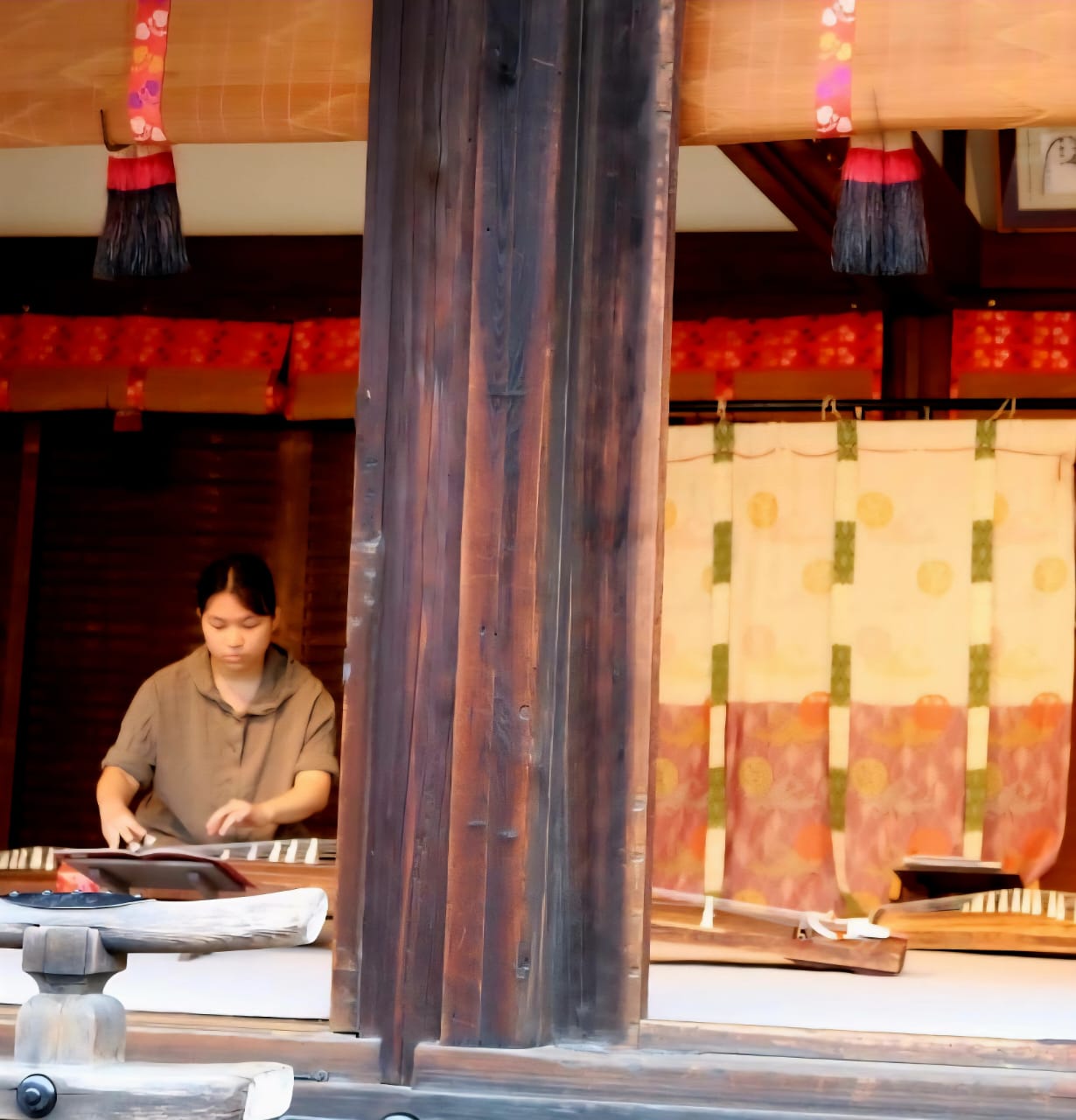
I enjoy reading, writing, learning languages, drawing/painting, and playing the koto and the violin.